[Ph.D. Dissertation Defense]
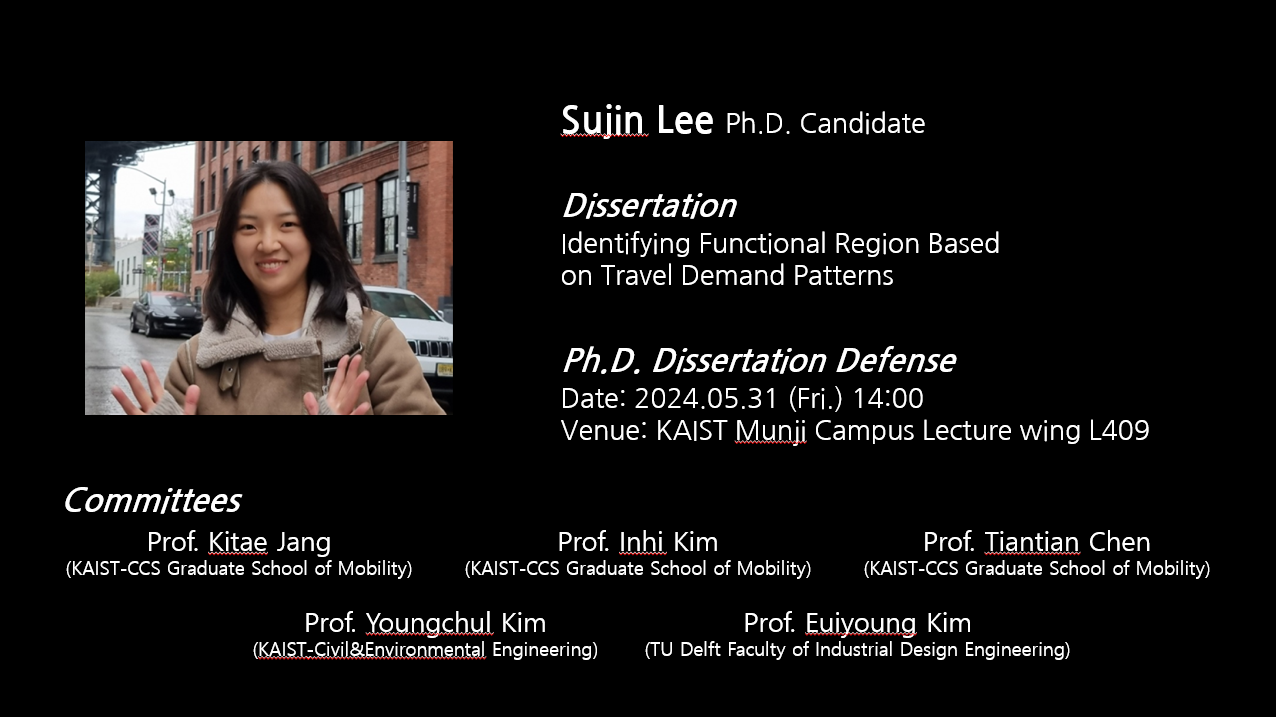
Ph.D.Candidate Sujin Lee
Abstract
Understanding functional regions resulting from interactions between people and regions is crucial for effective city planning and transportation management. Addressing potential deviations from planned functional regions, this study focuses on identifying how people actually utilize regions based on travel demand patterns. We propose a research framework consisting of three phases—extraction, validation, and application—using multi-modal travel demand datasets covering buses, taxis, and probe vehicles over a long-term period. In the extraction phase, regional clusters are identified based on similar temporal travel demand patterns across multiple transportation modes within a year, using t-distributed stochastic neighbor embedding and K-Means clustering methods. The validation phase aims to prove the distinctiveness of regional clusters at both collective and individual scales. Spatial characteristics, considering the built environment and socio-demography, interpret each regional cluster using Extreme Gradient Boosting and Shapley Additive Explanations, labeling regional clusters with representative functions. At the individual scale, differences in travel behavioral indices across functional regions, such as revisit interval and stay duration, are analyzed. In the application phase, functional regions, as indicators incorporating spatial-temporal features for each region, contribute to enhancing future travel demand forecasting. As a case study, our research framework is applied to the urban areas of Daejeon metropolitan city, South Korea. The study identifies six distinct functional regions, including residential areas (proximity to the city center and outskirts), industrial zones, business/education/research districts, commercial centers, and mixed-functional regions. It is also confirmed that individual travel behaviors vary across functional regions and that embedding functional region variables can enhance the predictability of demand for city services. This study provides a detailed understanding of the spatiotemporal dynamics linked with functional regions and offers valuable insights into regional functions illuminated by the analysis of travel demand patterns. These insights can support informed decisions in urban planning and transportation management
.
1. Date: Friday, May 31, 2024, 14:00
2. Venue: KAIST Munji Campus Lecture Hall L409