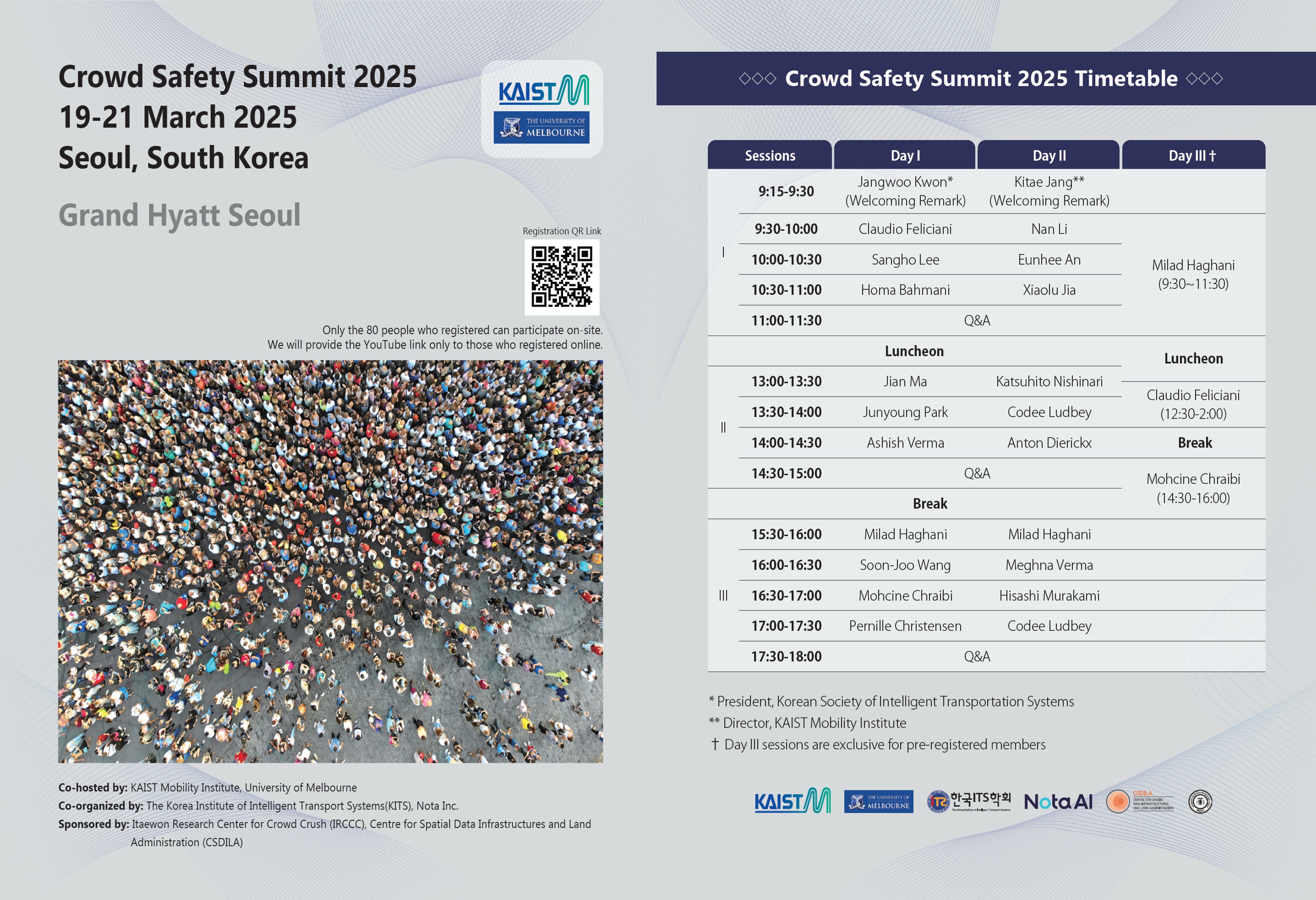
With topics as critical as the pulse of our modern cities, global experts in crowd safety, urban resilience, and emergency response will gather in Seoul, South Korea. From March 19th to 21st, 2025, the Crowd Safety Summit 2025 will take place at the Grand Hyatt Seoul, co-hosted by KAIST Mobility Institute and the University of Melbourne. This summit offers a rare and powerful convergence of professionals—from security management and counter-terrorism planning to pedestrian dynamics and simulation modeling—fostering a deep and multidimensional dialogue on how we design, manage, and protect crowded places. Participants will engage in in-depth sessions and hands-on workshops addressing the future of safe urban mobility and the design of secure built environments.
Seminar List
Video 1
- Cladio Feliciani – Order without orders: the future of crowd control
- Sangho Lee – Developing mobile crowd management system using Edge AI for preventing large-scale crowd surge incidents
- Homa Bahmani – Evacuation safety of young-age students within the context of existing school building: An experiment-based evacuation modelling
- Jian Ma – Accurate and fast evacuation process forecasting for complexed built environment
- Junyoung Park – What Happened in Itaewon on October 29, 2022: Focused on Crowd Surge
- Ashish Verma – Understanding dynamics of spiritually motivated crowd for their safety: A case study of world’s largest human
- Milad Haghani – Vehicular traffic models, fluid motion models, animal motion models, particle motion models – Do they have any place in crowd simulation?
- Soon-Joo Wang – A multidisciplinary approach for reducing casualties in crowd crush accidents: Efforts and limitations in the Itaewon Halloween Festival Tragedy
- Mohcine Chraibi – Enabling pedestrian dynamics research via software engineering: Modelling motivation and behaviour in bottleneck scenarios
- Pernille Christensen – Reconsidering crowded places protective security: An integrated project delivery approach
Video 2
- Nan Li – The effects of social relationship on pedestrian evacuation behaviours
- Xiaolu Jia – Navigating the obstacle: experiments, simulations, and empirical management at a railway station
- Katsuhito Nishinari – Crowd management platform and its application to Tokyo Dome City
- Codee Ludbey – Crowded places: Long-term security resilience in rail precinct design
- Anton Dierickx – Can data and technology enhance safety and efficiency at events? Challenges and best practices from Belgium and the Netherlands
- Milad Haghani – The theory of self-optimising crowds, or managing crowds from within – How does it work, what do we know so far, and what do we need?
- Meghna Verma – Understanding the Complex Behaviour of Tourists in Religious Mass Crowd Events: Insights from Kumbh Mela Ujjain 2016
- Hisashi Murakami – Understanding self-organisation in human crowds through body-part-movement tracking