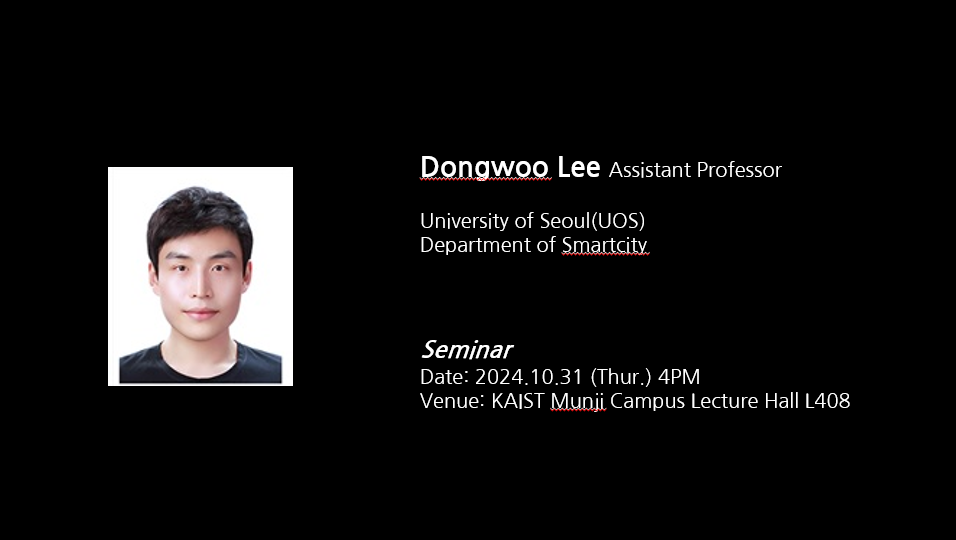
1. Speaker: Prof. Dongwoo Lee (University of Seoul)
2. Date: October 31, 2024 (Thursday) 16:00 ~ 17:30
3. Venue: KAIST Munji Campus Lecture Hall L409
4. Abstract: The first article addresses the challenging question in recent cities, “Do Our Cities Have Enough Transportation Welfare Policy, especially for the Older Population?”. In most cities, it is inevitable to face economic and social challenges, such as spatiotemporal disparities, which are exacerbated by recent changes in demographics and the impacts of pandemics. This article primarily fills the research gap in evaluating the impacts of mobility welfare to date, especially for subway fare exemption in Seoul. The efficiency of the fare exemption for elders as mobility welfare in Seoul has now become ambiguous after 40 years, especially regarding how this welfare policy will impact actual travel behaviors for older populations. To accurately quantify the impacts of policy, we adopted a Heterogeneous Causal Random Forest (HC-RF) to estimate the Heterogeneous Treatment Effect, analyzing policy impacts at individual and administrative district levels, revealing considerable variability in effectiveness. The results revealed that older citizens prefer subway use in areas with sufficient subway infrastructure. Although the results show that buses can become a primary alternative in areas with limited access to subways, the fare exemptions are limited to the subway only, which may lead to additional restrictions for older generations. In addition, regions with balanced subway and bus infrastructure display synergistic effects, enhancing overall mobility for elders. Based on the findings, this article provides useful insights about future mobility welfare policies, especially for expanding fare exemption to improve older citizens’ mobility, social participation, and quality of life in cities.
The second article primarily investigates the impacts of commuting time on work-life balance. Balancing working hours and household tasks is a determining factor for overall life satisfaction. Due to the long-held norms in gender responsibility, women’s primary responsibility for caregiving remains substantial. Although the normative nature of gender roles may not be mitigated immediately, efforts in urban planning and policies can change patterns of work-life behaviors. Therefore, this article seeks to answer the following research question: “Do urban morphological changes enhance the overall subjective well-being in cities? Previous policy efforts are merely established by independent silos and even conflicting paradoxical policies each other. This article hypothesizes that holistic urban strategies simultaneously integrating housing, transit, and work agreements can effectively enhance work-life balance and quality of life while minimizing gender disparities to some extent. To address this question, the ordered logistic regression is used to understand the relationships between subjective well-being and various factors that can affect life satisfaction. In addition, the boosted mixed effect model is adopted further to investigate gender disparities in household tasks and commuting. The results reveal that there is gender disparity in life satisfaction, while both men and women are negatively affected by commuting time. During COVID-19, however, the impact of commuting time is trivial. In addition, commuting time exacerbates gender disparities in household tasks. Consequently, the analyses imply that holistic approaches in urban contexts will likely increase overall life satisfaction in cities while alleviating the nature of gender responsibility.
Lastly, analyzing traffic accidents and associated behaviors is notoriously challenging. This is mainly because crashes and their severities involve inherent epistemic uncertainties that arise from a lack of information. Furthermore, the complex and interconnected nature of crashes cannot be easily addressed by modeling approaches with strong predetermined assumptions in traditional statistical modeling. To alleviate uncertainties, this article develops a mixed-effect tree ensemble with a Gaussian process (MEGP). In particular, a tree ensemble is adopted to better predict the discrete nature of police-reported accident data, and the nonparametric Gaussian process enables the capture of nonlinearities and discontinuities in estimating random parameters. The generalized accident risk index is introduced to better predict the uncertain nature of crashes and severities. To quantify accident factors and provide practical political implications, we added scalable interpretation to the model-agnostic interpretation, such as Shapley value considering spatiotemporal correlation and unobserved heterogeneity. To quantify accident factors and provide practical political implications, we added scalable interpretation to the model-agnostic interpretation, such as Shapley value considering spatiotemporal correlation and unobserved heterogeneity. The result showed that ME-GP yields the best prediction performance, especially on out-of-sample predictions. Moreover, ME-GP shows lower prediction variance, indicating greater model robustness and addressing uncertainty compared with group effect models. Most variables show a nonlinear relationship with accident risk while representing potential correlations between variables and accident risk. These results demonstrate that the nonparametric Gaussian process method, which simultaneously accounts for spatial correlations and unobserved heterogeneity, outperforms parametric methods and other data-driven methods.