
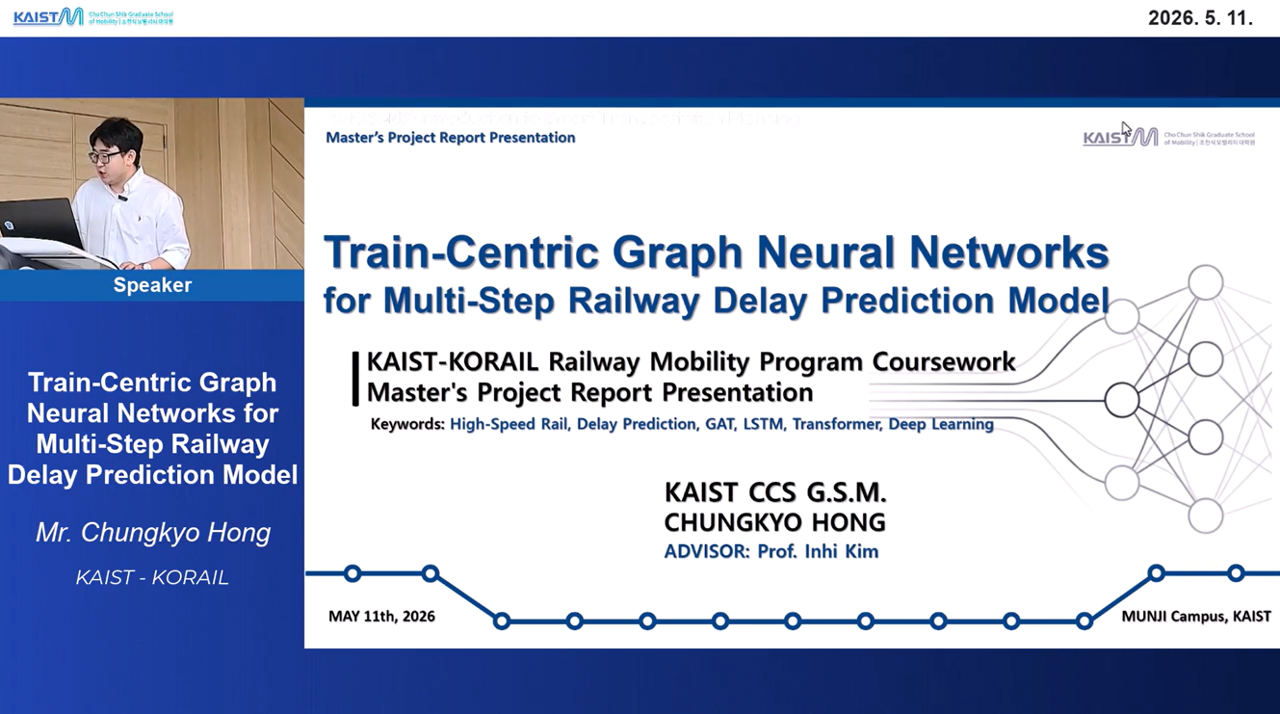
- 발표자 : 홍충교 (Chungkyo Hong)
- 일 시 : 2026. 05. 11
- 소 속 : KAIST–KORAIL (Cho Chun Shik Graduate School of Mobility)
- 구 분 : 석사 학위 논문 심사 (M.S. Graduation Project Defense)
Train-Centric Graph Neural Networks for Multi-Step Railway Delay Prediction Model
Abstract
This video presents an M.S. Graduation Project defense at KAIST–KORAIL.
The research focuses on enhancing the accuracy of multi-step railway delay prediction for high-speed rail operations. While existing systems often focus on monitoring current delay states or predicting immediate next-station delays, this study addresses the propagation of delays across the rail network by modeling dynamic interactions between active trains. By shifting the modeling focus from static stations to “train-centric” dependencies, the research aims to provide more precise and interpretable forecasts for complex, cascading delay scenarios.
Using a comprehensive dataset of one year’s operation logs from Korea’s High-Speed Rail (KTX and SRT) in 2025, the study proposes a Train-Centric Graph Neural Network (GNN) framework. The methodology integrates Graph Attention Networks (GAT) to capture spatial operational dependencies with controlled temporal decoders—specifically comparing LSTM and Transformers—for multi-horizon forecasting. The findings demonstrate that architecture preference varies across different delay regimes, highlighting the importance of regime-aware model selection for robust railway traffic management.
Presentation Overview
This presentation covers the following key topics:
- Transitioning from delay monitoring to delay propagation forecasting
- Train-centric graph construction for dynamic operational dependencies
- Comparative analysis of temporal decoders: LSTM vs. Transformer
- Horizon-wise performance and delay-regime sensitivity analysis
- Attention-based interpretation of train-to-train delay propagation