- Speaker : Prof. Zhibin Chen
- Date : July 6, 2026
- Affiliation : Assistant Professor, New York University Shanghai / Global Network Assistant Professor, New York University
- Category : Special Lecture (2026 Jeju Summer Camp)
Cost-effectiveness of Modular Transit Systems
Abstract
This second special lecture at the 2026 Jeju Summer Camp asks whether modular transit built on modular autonomous vehicles can be a cost-effective alternative to the transit we already run. The question sits on an old trade-off. Fixed-route service is cheap to operate but inflexible, while on-demand service is flexible but expensive, and neither mode resolves the tension on its own.
Modular autonomous vehicles have drawn attention because they can couple and decouple while still moving, a manoeuvre known as in-motion transfer. Most earlier work studied one operational feature at a time, and few studies weighed the costs and benefits of adopting these vehicles across a whole system. The lecture builds comparable continuum approximation models for three systems, modular, conventional fixed-route, and on-demand, each accounting for user costs of walking, waiting, and in-vehicle travel alongside agency cost in one framework.
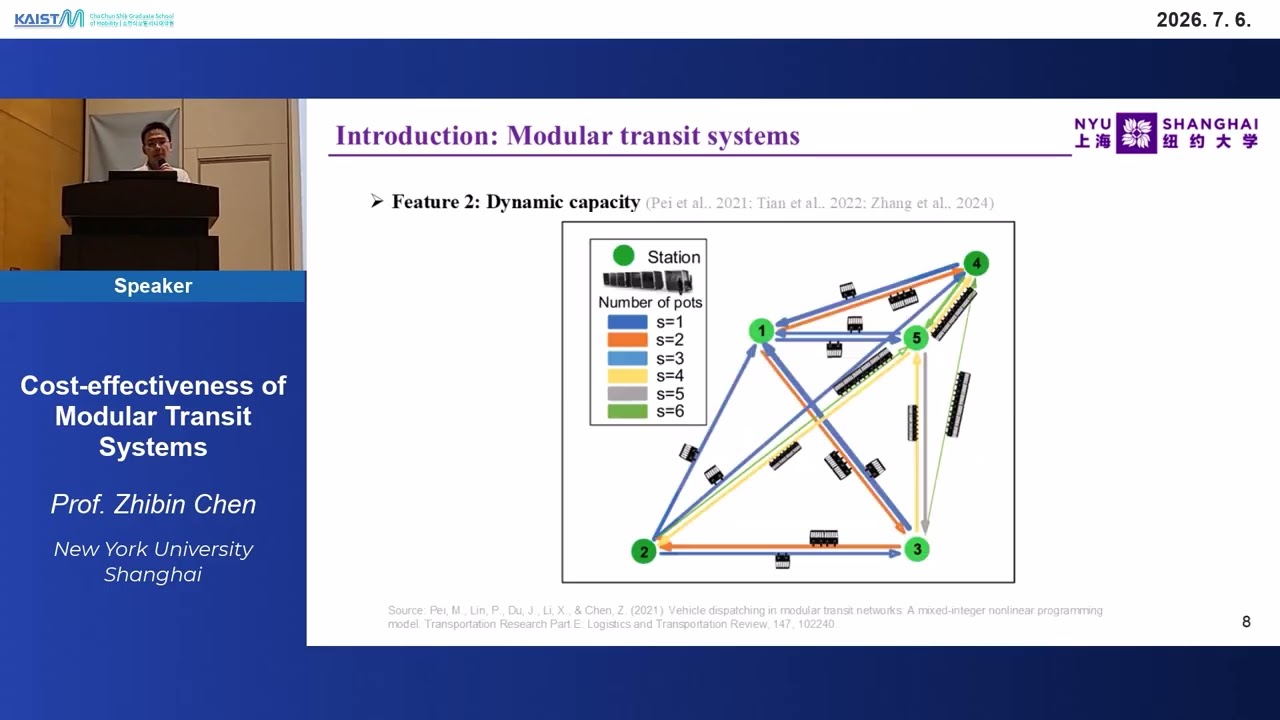
The models carry the defining traits of modular transit: stop-less corridor operation through in-motion transfer, capacity that adapts to demand, pickup-and-delivery service with shorter detours, and synchronization among vehicle platoons. Analytical propositions on optimal headway, cost structure at the optimum, and budget-constrained deployment then show when each mode wins, and for whom.
Presentation Overview
This presentation covers the following key topics:
- Motivation: the structural trade-off between fixed-route and on-demand transit, global transit policy trends, and why neither mode settles the tension between cost and flexibility
- Modular autonomous vehicles: what they are, how in-motion transfer lets capacity be used efficiently and flexibly, and where real pilot deployments stand
- Research gap and objective: why a whole-system cost-effectiveness analysis has been missing, and how comparable continuum approximation models for three systems make a fair comparison possible
- Key features of modular transit: stop-less corridor operation through in-motion transfer, dynamic capacity that follows demand, pickup-and-delivery service with detour reduction, and synchronization among platoons
- Modelling framework: a rectangular service region with homogeneous demand under Manhattan distance, with total cost split into walking, waiting, and travel time for users plus an agency cost linear in capacity
- System formulations: fixed-route service with evenly spread stations and zones, the modular system with a bi-directional corridor, unidirectional pickup-and-delivery service and rearrangement hubs, and on-demand service under a no-backtracking routing policy
- Analytical results: optimal headways for each mode, how they behave as the corridor lengthens, and why a long modular corridor does not need higher frequency the way the other two modes do
- Cost structure at the optimum: why per capita walking cost rises with service scale for fixed-route transit but falls for the modular system, and the condition under which modular service beats fixed-route on walking plus travel cost
- Budget-constrained deployment: the minimum required budget, the demand and automation thresholds that favour modular operation, and why on-demand service becomes the most user-friendly mode only once the budget is large enough
- Takeaways: high demand and autonomous driving favour modular operation, the modular system gives the lowest user cost under intermediate budgets, and modular transit works best as a complement that widens the range of operating modes rather than replacing them