
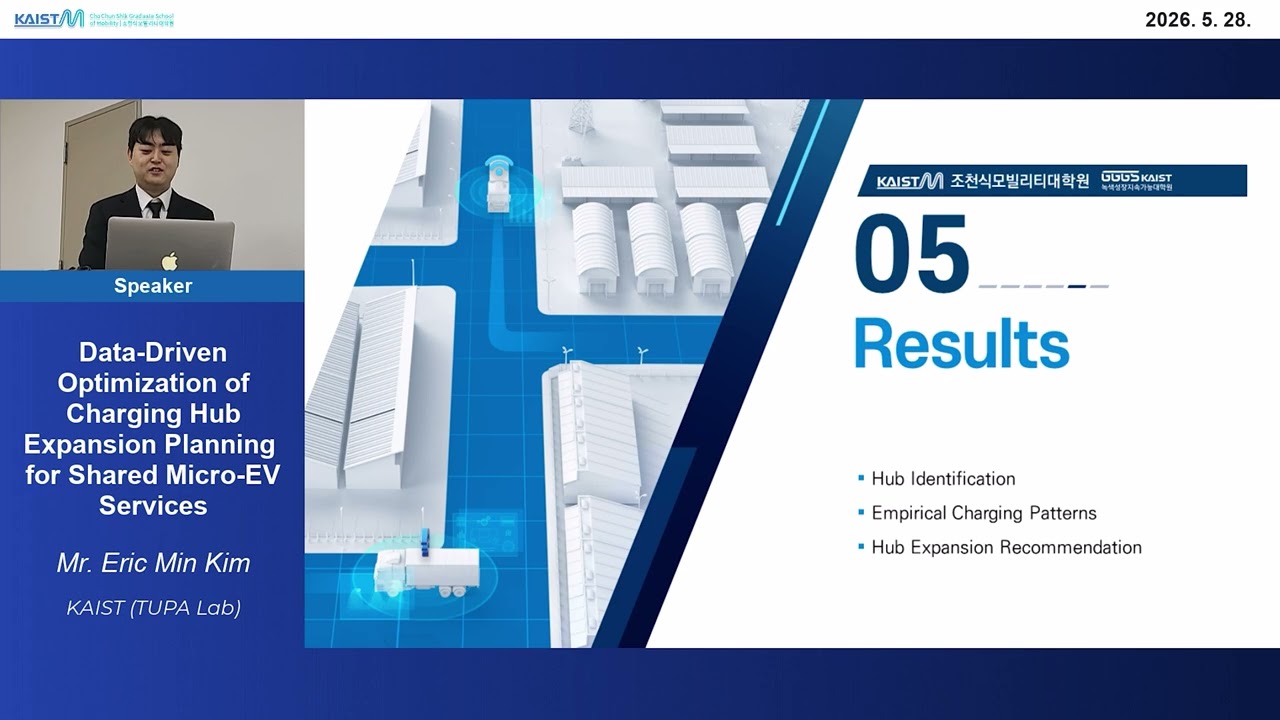
- Presenter : Eric Min Kim (TUPA LAB)
- Date : May 28, 2026
- Affiliation : KAIST (Cho Chun Shik Graduate School of Mobility)
- Category : M.S. Thesis Defense
Data-Driven Optimization of Charging Hub Expansion Planning for Shared Micro-EV Services
Abstract
This video presents the M.S. thesis defense of Eric Min Kim (TUPA), on optimizing shared micro-EV charging hubs. The research builds a data-driven decision-support framework for charging hub expansion planning in station-based shared micro-EV services. Micromobility research has mostly focused on e-bikes and e-scooters, and existing EV models cater mainly to private vehicles, which leaves shared micro-EVs underexplored.
A key difficulty in infrastructure planning is that observed charging data are supply-confounded: charging can only be seen where chargers already exist, which makes latent demand at new greenfield sites hard to estimate. The study uses vehicle telematics from 80 vehicles across Daejeon, Mokpo, and Jeju to separate trip-end dwell behavior from conditional charging behavior. By estimating a supply-attenuated greenfield demand surface, the framework applies a Mixed-Integer Linear Program (MILP) to optimize candidate hub locations and charger counts. A core contribution is showing that this supply-attenuated approach selects substantially different greenfield hub sets from traditional supply-confounded models, and that expansion is driven mainly by coverage rather than pure energy capacity.
Presentation Overview
This presentation covers the following key topics:
- Research background and objectives: the challenges of supply-confounded observations in shared micro-EV charging hub expansion
- Telemetry reconstruction: detecting charging and dwell events from vehicle-side State of Charge (SOC) changes
- Supply-attenuated demand forecasting: separating dwell intensity from charging behavior to estimate greenfield demand
- Candidate generation and hub optimization: using a capacitated facility-location MILP model
- Results: region-specific hub identification and expansion recommendations for Daejeon, Mokpo, and Jeju
- Discussion: operational implications, robustness validation, and limitations