
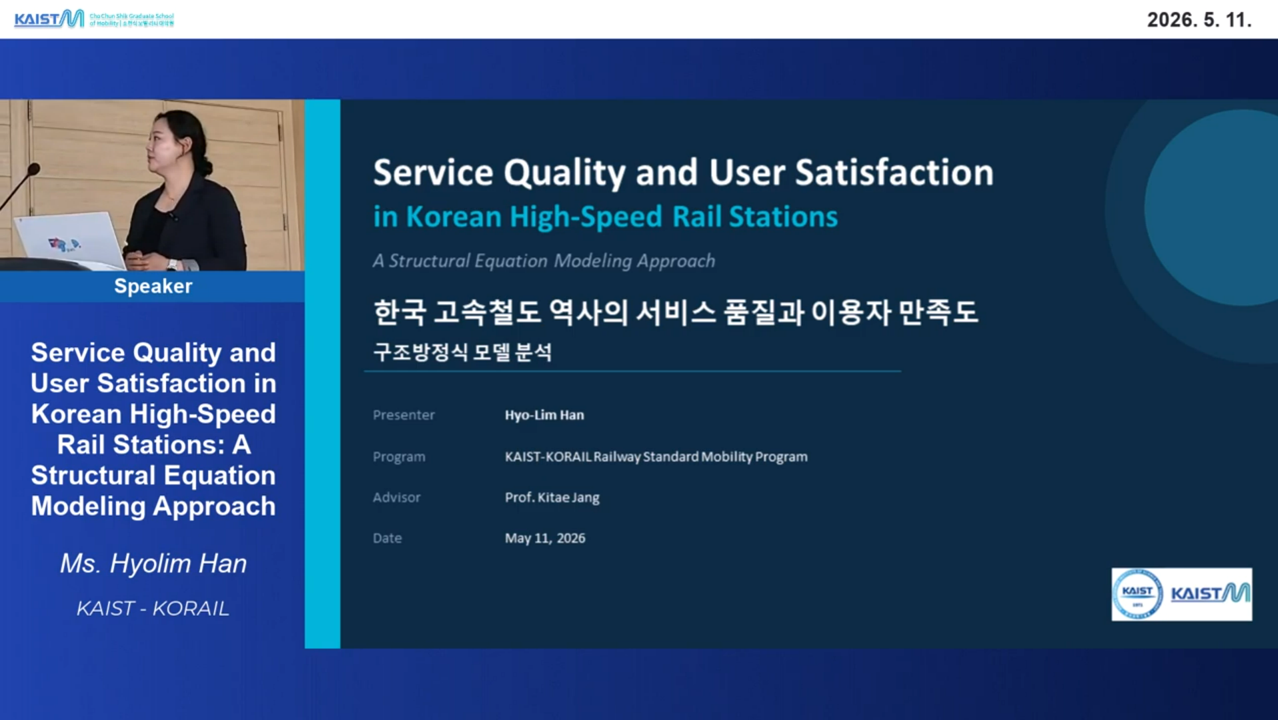
- 발표자 : Hyo-Lim Han (TOPS LAB)
- 일 시 : [Date, e.g., 2026. 05. 11]
- 소 속 : KAIST–KORAIL
- 구 분 : 석사 학위 논문 심사 (M.S. Graduation Project Defense / Railway Standard Mobility Program)
Service Quality and User Satisfaction in Korean High-Speed Rail Stations: A Structural Equation Modeling Approach
Abstract
This video presents a research presentation for the KAIST–KORAIL Railway Standard Mobility Program.
The research establishes a framework for evaluating service quality and user satisfaction at Korean high-speed rail (HSR) stations. While previous studies have primarily focused on overall rail services or commuter systems, this study addresses the critical research gap by specifically targeting station-level touchpoints, which are often more cost-effective to improve than train operations.
Using a large-scale online survey dataset of 1,020 KTX and SRT passengers, the study derives six core service quality factors—Comfort, Information, Safety, Staff Service, Convenience, and Facilities—based on the SERVQUAL framework and Servicescape theory. The research applies a dual-model approach: Multiple Regression Analysis (OLS) to examine how user characteristics (such as age, dwell time, and mobility impairments) influence service evaluations, and Covariance-Based Structural Equation Modeling (CB-SEM) to test the causal relationships between service quality, overall satisfaction, and reuse intention.
A core finding is that Facility quality and Information provision are the most significant drivers of passenger satisfaction, which strongly dictates long-term reuse intention. The framework also reveals segmented perceptions, highlighting the need for universal design and targeted strategies for elderly and mobility-constrained users.
Presentation Overview
This presentation covers the following key topics:
- The critical research gap in station-level service quality for high-speed rail networks
- Theoretical derivation of six Service Quality Factors from the SERVQUAL framework
- Survey design and data collection involving 1,020 respondents
- Dual-model analytical methodology using Multiple Regression and CB-SEM
- Empirical evidence on how user characteristics affect service evaluations
- Identification of Facility quality and Information provision as dominant satisfaction drivers
- Policy implications for HSR station improvements, including universal design and real-time information systems