
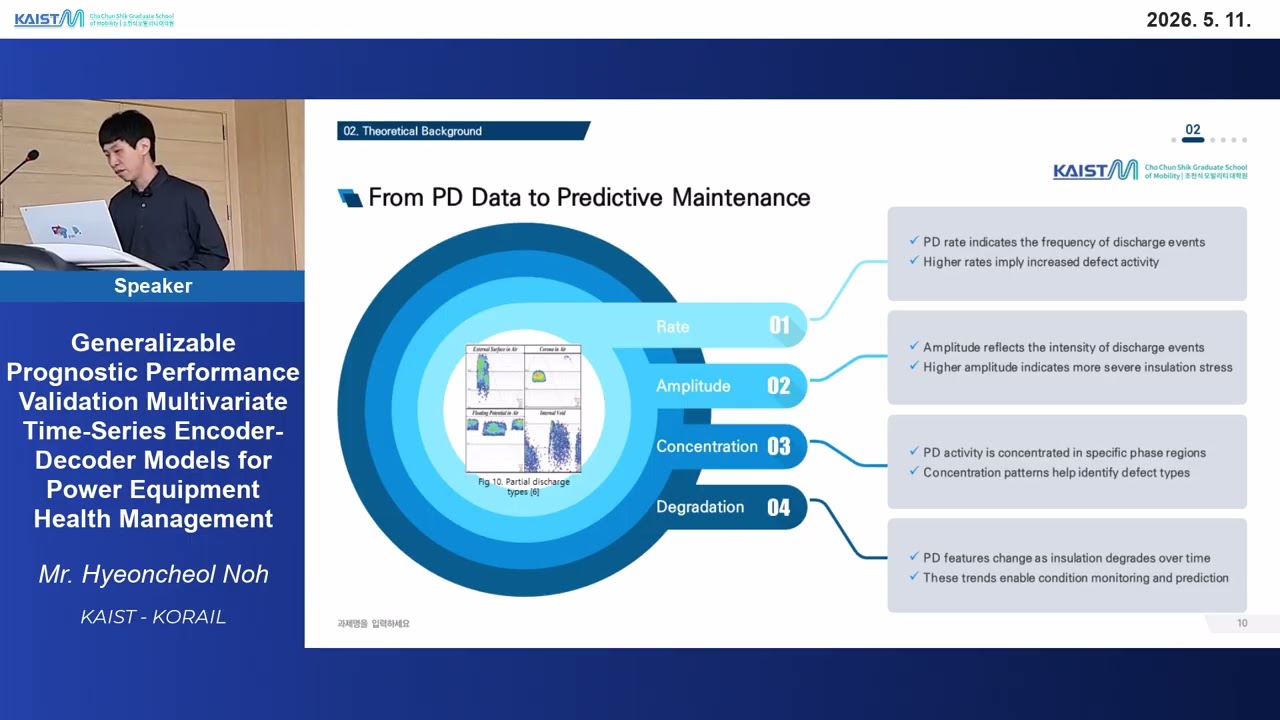
- Presenter : Hyeoncheol Noh (TUPA LAB)
- Date : May 11, 2026
- Affiliation : KAIST–KORAIL (Cho Chun Shik Graduate School of Mobility)
- Category : M.S. Thesis Defense
Generalizable Prognostic Performance Validation of Multivariate Time-Series Encoder-Decoder Models for Power Equipment Health Management
Abstract
This video presents the M.S. degree defense of Hyeoncheol Noh (TUPA) at KAIST–KORAIL (Cho Chun Shik Graduate School of Mobility), on railway predictive maintenance for power equipment. The research builds a data-driven framework that moves railway asset management away from fixed time-based schedules, which ignore the actual condition of equipment and can lead to unexpected failures or unnecessary maintenance.
The study proposes an AI-based approach that shifts toward condition-based maintenance (CBM) and enables early failure prediction. Using multivariate Partial Discharge (PD) data, with features such as rate, amplitude, concentration, and degradation, it introduces a Time-Series Encoder-Decoder LSTM architecture. A core contribution is the model’s ability to capture complex temporal dependencies and perform recursive multi-step forecasting for long-term sequence generation. The framework shows that the LSTM-based approach outperforms traditional models such as ARIMA, giving accurate prognostic performance to support maintenance scheduling and asset upgrade decisions.
Presentation Overview
This presentation covers the following key topics:
- Safety risks from aging railway infrastructure and the transition to predictive maintenance
- Theoretical background on partial discharge mechanisms and insulation degradation
- Multivariate time-series data preparation and feature extraction pipelines
- The proposed predictive maintenance framework using an Encoder-Decoder LSTM model
- Experimental results, including the effect of initial conditions and step-size comparisons
- Comparison of prediction performance between the LSTM and ARIMA models