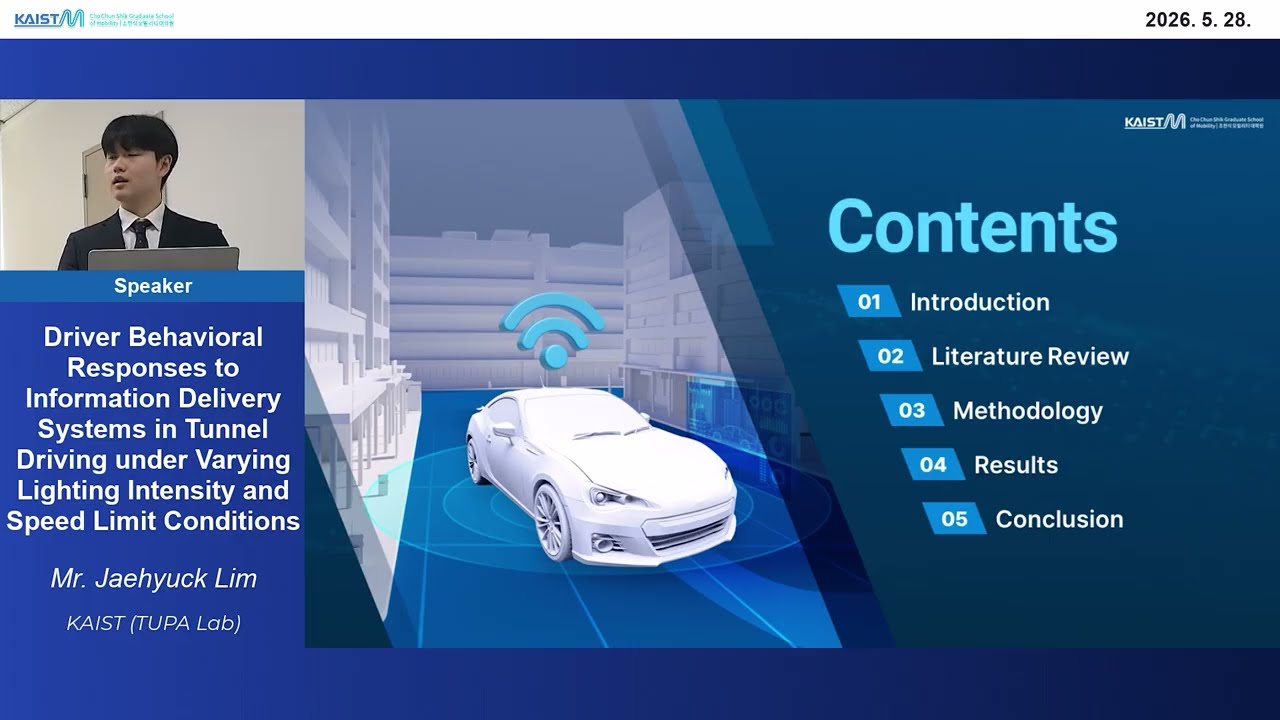
- Presenter : Jaehyuck Lim (TUPA LAB)
- Date : May 28, 2026
- Affiliation : KAIST (Cho Chun Shik Graduate School of Mobility)
- Category : M.S. Thesis Defense
Driver Behavioral Responses to Information Delivery Systems in Tunnel Driving under Varying Lighting Intensity and Speed Limit Conditions: A Multi-Agent VR Driving Simulator Study
Abstract
This video presents the M.S. thesis defense of Jaehyuck Lim (TUPA), on tunnel driving safety and how drivers respond to information delivery systems during tunnel driving. The research examines Variable Message Signs (VMS) and Head-Up Displays (HUD) under varying lighting intensity and speed limit conditions. Traditional tunnel safety measures focus on infrastructure and environmental improvements, which are often limited by high implementation costs, physical constraints, and little consideration for inter-vehicle interactions.
The study proposes a multi-agent Virtual Reality (VR) driving simulator approach that evaluates both individual driving behavior and vehicle-to-vehicle interaction stability. Using a VR simulator dataset from 32 licensed participants navigating a three-lane tunnel with a stopped-vehicle scenario, it shows that VMS and HUD improve safety through different mechanisms. VMS builds a larger spatial margin through early roadside information and gradual speed reduction, while HUD builds a temporal margin through in-view dynamic warnings that support immediate hazard responses.
Presentation Overview
This presentation covers the following key topics:
- Research background and objectives: the need for proactive, information-based safety measures in tunnel driving
- Methodology: the multi-agent VR driving simulator setup and scenario configuration
- Individual and inter-vehicle results: how VMS and HUD reduce speed, harsh braking, and brake reaction time
- Two mechanisms, two margins: VMS for spatial safety margins and HUD for temporal safety margins
- Moderating effects: the impact of tunnel luminance (bright vs. dark) and speed limit (80 km/h vs. 100 km/h)
- Discussion and conclusion: design and policy implications for tunnel information delivery systems