- Presenter : Kexin Zhu (TUPA LAB)
- Date : May 28, 2026
- Affiliation : KAIST (Cho Chun Shik Graduate School of Mobility)
- Category : M.S. Thesis Defense
Dynamic Response Patterns and Safety Implications of Electric Scooter Riders in Hazard Scenarios: A Group-Based Trajectory Modeling Approach
Abstract
This video presents the M.S. thesis defense of Kexin Zhu (TUPA), on how electric scooter riders react when a hazard develops with a nearby motor vehicle. The research examines the way riders coordinate speed and steering during the hazard itself. Hazard reaction studies have mostly examined car drivers, and existing e-scooter safety work has centered on post-crash outcomes and broad risk factors, so rider-level behavior in the moment a hazard unfolds remains underexplored, particularly the timing between slowing down and steering away.
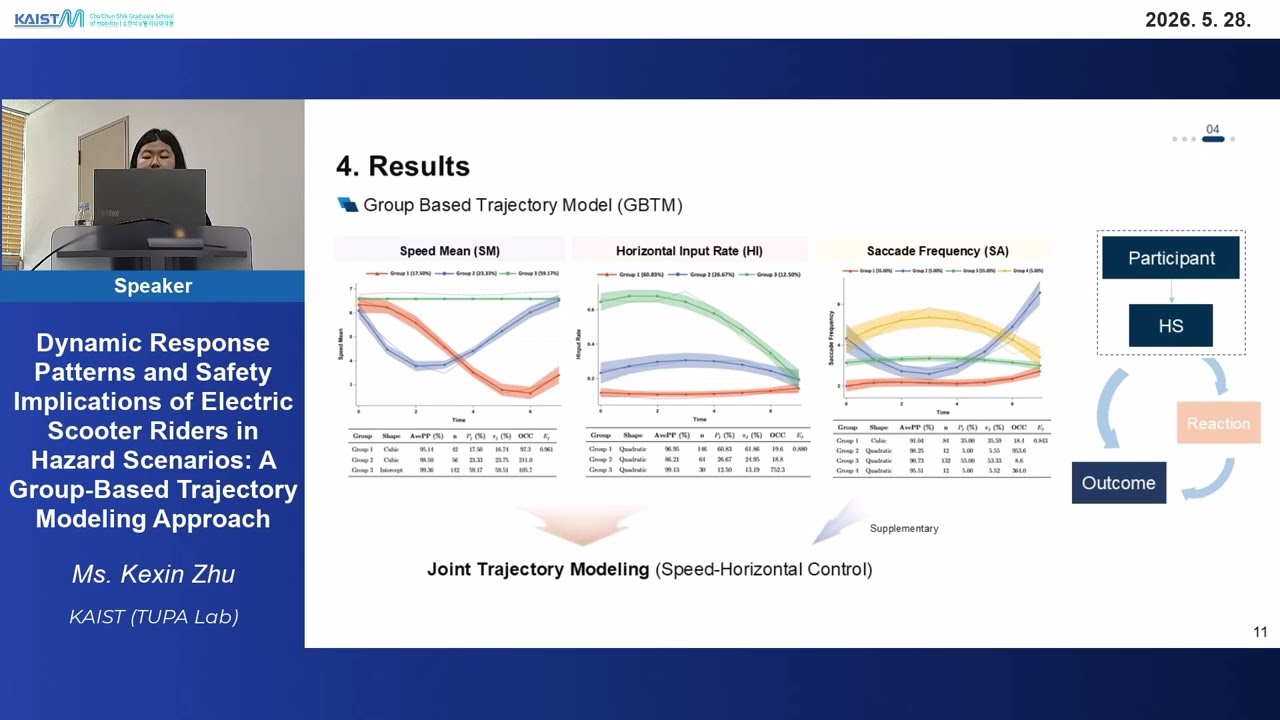
To close that gap, the study pairs a VR headset with a 4-axis scooter simulator and records how 32 riders respond across several hazard scenarios involving interacting vehicles. A Group-Based Trajectory Modeling (GBTM) approach, applied jointly to speed and horizontal control, identifies distinct reaction patterns and links them to safety risk through Predicted Time-to-Collision (PTTC). Mixed-effects model comparisons then weigh how much the hazard scenario, the reaction pattern, and individual rider differences each contribute to the safety outcome.
Presentation Overview
This presentation covers the following key topics:
- Research background and objectives: motor-vehicle involvement in e-scooter injuries and the limits of driver-centered hazard reaction research
- Literature review: gaps in existing e-scooter safety and two-wheeler steering studies, and the case for joint speed and horizontal control reaction modeling
- Methodology: the VR and 4-axis scooter simulator design, a 32-rider sample, and GBTM-based joint trajectory modeling
- Results: distinct speed and horizontal reaction groups, how they distribute across hazard scenarios, and their association with PTTC-based safety risk
- Model comparison: the relative contribution of hazard scenario, reaction pattern, and rider-level factors to PTTC prediction
- Discussion: safety implications, how to read the reaction patterns, and study limitations