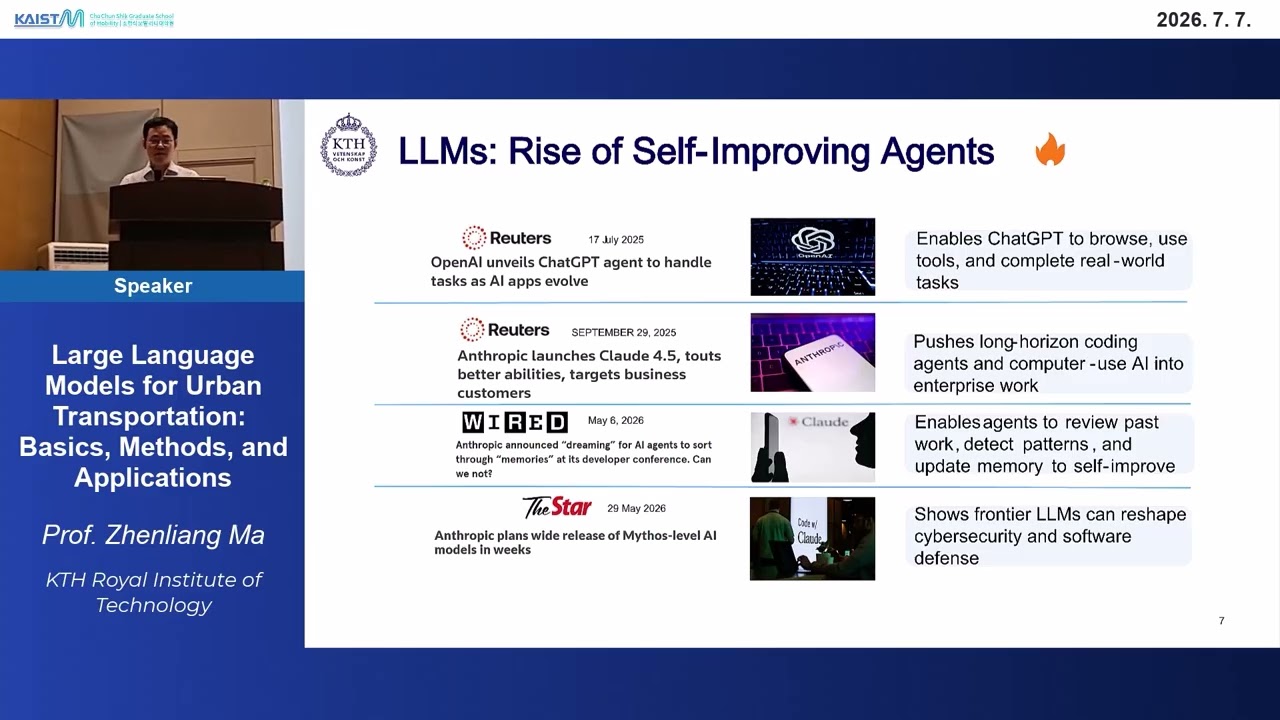
- Speaker : Prof. Zhenliang Ma
- Date : July 7, 2026
- Affiliation : KTH Royal Institute of Technology, Sweden
- Category : Special Lecture (2026 Jeju Summer Camp)
Large Language Models for Urban Transportation: Basics, Methods, and Applications (I)
Abstract
This special lecture at the 2026 Jeju Summer Camp looks at what LLMs for urban transportation can actually do, connecting how modern large language models work to practical methods for prediction, optimization, simulation, and mobility system design.
It opens with how these models have evolved, from conversational systems to reasoning models and self-improving agents, and explains the architectures behind them, the training stages of pre-training, supervised fine-tuning, and reinforcement learning from human feedback, and the strategies used to push their capability further. From there the lecture sets out a systematic pipeline for pointing a language model at an engineering problem.
Five urban mobility case studies carry the second half. They span day-to-day route choice, individual mobility prediction, pedestrian behaviour, and traffic signal control, including an algorithm discovery agent that improved its evaluation score by 21.5 percent, cut vehicle delay by 20.1 percent, and reduced stops by 47.1 percent through iterative program evolution.
Presentation Overview
This presentation covers the following key topics:
- LLM fundamentals: foundation models, self-attention, encoder-based and decoder-based architectures, and the path through pre-training, supervised fine-tuning, and reinforcement learning from human feedback
- Reasoning and agentic learning: reinforcement learning with verifiable rewards, agentic reinforcement learning, tool use, memory, planning, and long-horizon decision-making
- Enhancing model capability: prompt engineering, in-context learning, chain-of-thought reasoning, self-refinement, retrieval-augmented generation, and single-agent and multi-agent systems
- Building reliable agents: harness engineering through context management, tools, memory, guardrails, verification, and human approval, plus self-evolving agents that improve on feedback
- Efficient adaptation: parameter-efficient fine-tuning with LoRA, knowledge distillation from larger teacher models, synthetic reasoning datasets, and reinforcement learning for reasoning
- LLMs for engineering problems: workflows for prediction, optimization, and simulation, with domain-specific prompting, fine-tuning, automated evaluation, algorithm generation, and explainable output
- LLMTraveler, agentic LLMs for day-to-day route choice: whether model-based travellers reproduce human route-switching behaviour and converge toward user equilibrium
- LingoTrip, prompt-based individual mobility prediction: spatiotemporal context and zero-shot chain-of-thought prompting to predict a traveller’s next trip origin, tested on Hong Kong smart-card data
- MoBLLM, a foundation model for individual mobility prediction: fine-tuning an open-source LLM across GPS trajectories, check-in records, and public-transport data for several tasks, cities, and travel conditions
- Prediction under changing conditions: transferability and robustness across unseen datasets, network changes, policy interventions, social events, and traffic incidents
- AgentVision, video-language reasoning for pedestrian crossing intention: combining visual observation with language-based reasoning to predict whether a pedestrian will cross within the next one to two seconds
- Real-world autonomous driving validation: open datasets, laboratory and hardware-in-the-loop experiments, closed-course trials, and demonstrations at the Arlanda test track
- EvolveSignal, an LLM-powered coding agent for traffic signal control: code generation, evolutionary search, program evaluation, and SUMO simulation used to discover better signal control algorithms, reaching a 21.5 percent gain in evaluation score, 20.1 percent less vehicle delay, and 47.1 percent fewer stops
- Ongoing directions: LLM-based knowledge graph construction, semantic domain-concept extraction, zero-shot taxonomy induction, controllable synthetic population generation, traffic assignment, and adaptive signal control
- Takeaways: paired with mobility data, simulation environments, multimodal perception, external tools, memory, and automated evaluation, these models act as predictors, behavioural agents, engineering assistants, and algorithm-discovery systems