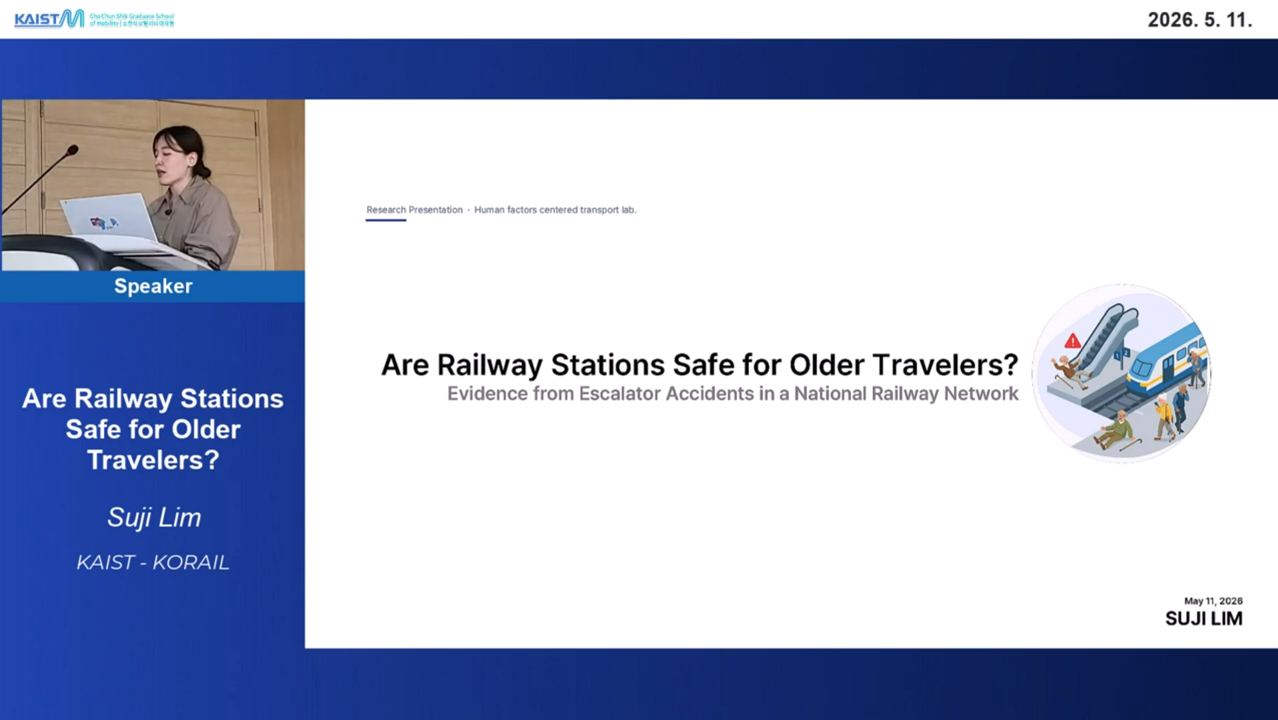
- 발표자 : Suji Lim (HFACTS LAB)
- 일 시 : [Date, e.g., 2026. 05. 11]
- 소 속 : KAIST–KORAIL (Human Factors Centered Transport Lab)
- 구 분 : 석사 학위 논문 심사 (M.S. Graduation Project Defense)
Are Railway Stations Safe for Older Travelers? Evidence from Escalator Accidents in a National Railway Network
Abstract
This video features a research presentation from the Human Factors Centered Transport Lab at KAIST–KORAIL, addressing the critical issue of escalator safety for older passengers.
As South Korea rapidly transitions into a super-aged society—with the elderly population projected to reach 47.5% by 2070—railway stations face unique safety challenges. Escalators represent a major station risk, accounting for 30.54% of all station accidents, and older passengers (aged 60 and above) are disproportionately affected, being involved in nearly 70% of these incidents. To provide nationwide, evidence-based safety solutions, this study analyzes a massive operational dataset encompassing 2,875 escalators across 306 KORAIL stations from 2020 to 2024.
To overcome the methodological limitations of previous studies—specifically the “excess zeros” where many escalators record no accidents—the researcher applies a Two-Stage Hurdle Poisson Model. This innovative approach separates accident occurrence (whether an accident happens at all, modeled via Binary Logit) from accident frequency (how many repeated accidents occur, modeled via Zero-Truncated Poisson). The empirical results reveal that upward-moving escalators are the dominant risk factor for both occurrence and frequency, accounting for 72.4% of all accidents. Surprisingly, while longer escalators increase the frequency of repeated accidents, higher speeds and greater heights actually show a negative association with repeated accidents, potentially due to passengers exercising greater caution.
Presentation Overview
This presentation covers the following key topics:
- The growing necessity for inclusive station design in a super-aged society
- Methodological approaches for handling zero-inflated accident data using a Two-Stage Hurdle Poisson Model
- Detailed descriptive statistics of escalator physical characteristics (length, height, speed, direction) and station environments
- Empirical evidence proving that upward-direction escalators require significantly greater boarding coordination
- The counterintuitive finding that slower speeds do not inherently guarantee safety
- Actionable policy implications, including exposure management, consistent speed maintenance, and direction-specific interventions like improved step-edge markings