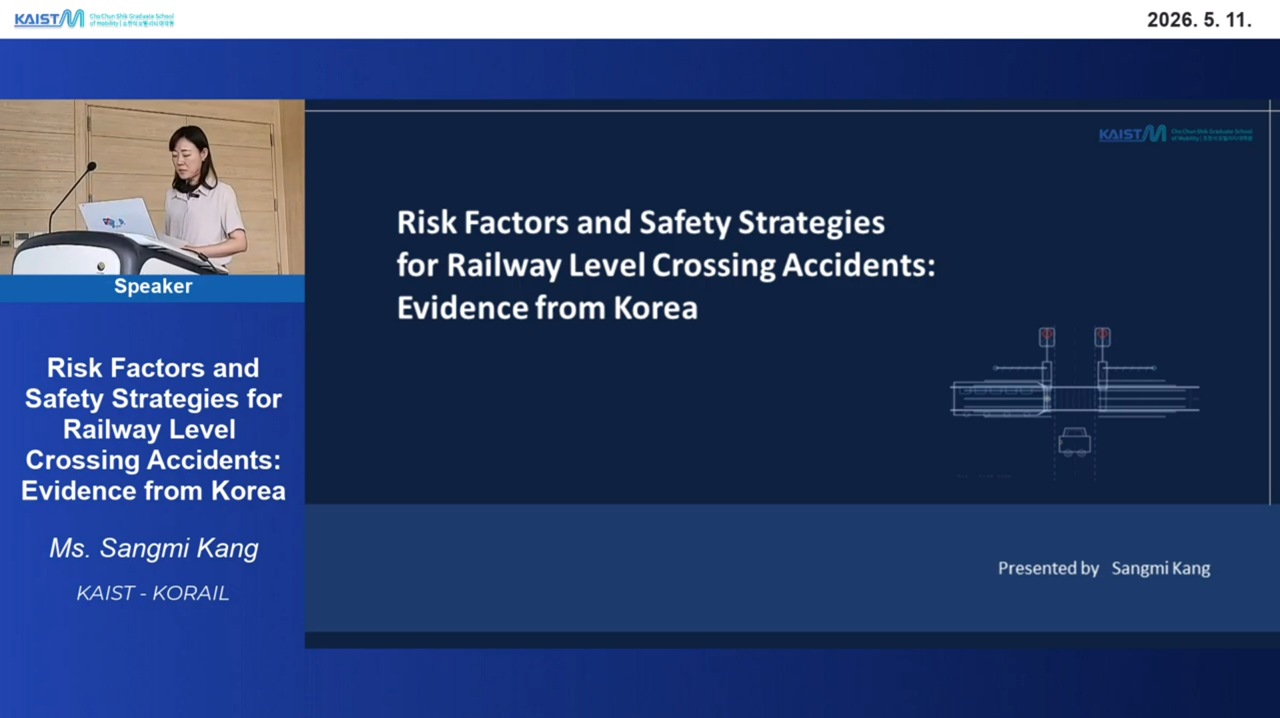
- 발표자 : Sangmi Kang (HFACTS LAB)
- 일 시 : [Date, e.g., 2026. 05. 11]
- 소 속 : KAIST–KORAIL (Cho Chun Shik Graduate School of Mobility)
- 구 분 : 석사 학위 논문 심사 (M.S. Graduation Project Defense)
Risk Factors and Safety Strategies for Railway Level Crossing Accidents: Evidence from Korea
Abstract
This video presents a research presentation on railway safety for the KAIST–KORAIL program.
Railway Level Crossings (RLCs) are structurally vulnerable intersections where road and rail traffic share the same grade, leading to a disproportionately high fatality rate during collisions. While previous studies have identified various risk factors, they often struggle with small sample sizes and fail to quantify the actual impact of safety policies. To bridge this gap, this study establishes a quantitative framework to evaluate accident severity and simulate policy effectiveness.
Using an integrated 7-year dataset (2018-2024) of Korean RLC accidents, the research applies SMOTE-NC (Synthetic Minority Oversampling Technique) to overcome small data constraints while preserving the original multi-level severity structure (Property Damage Only, Serious Injury, and Fatal Injury).
A Multinomial Logit (MNL) model is then used to pinpoint the specific factors driving accident severity. A core contribution is the study’s counterfactual simulation framework, which translates the model’s coefficients into actionable policy metrics. The results demonstrate that while vulnerable road users face the highest fatal risks, upgrading unmanned crossings to intelligent active-control systems can reduce fatal accident probabilities by 76.1%, and implementing strict speed management can yield a 32.2% reduction.
Presentation Overview
This presentation covers the following key topics:
- The structural vulnerabilities of RLCs and the limitations of previous small-sample safety studies
- Data construction and validation using a comprehensive KORAIL and Rail Safety Information System (RSIS) dataset
- The application of SMOTE-NC to resolve data imbalance and prevent the loss of critical severity details
- Multinomial Logit (MNL) model configuration for analyzing infrastructure, operational, human, and temporal risk factors
- Empirical evidence showing how unmanned crossings, train speed, and human vulnerability escalate fatal outcomes
- Counterfactual simulations that quantify the precise risk-reduction impact of safety interventions
- A phased safety policy roadmap, ranging from short-term speed regulations to long-term intelligent surveillance and physical separation