
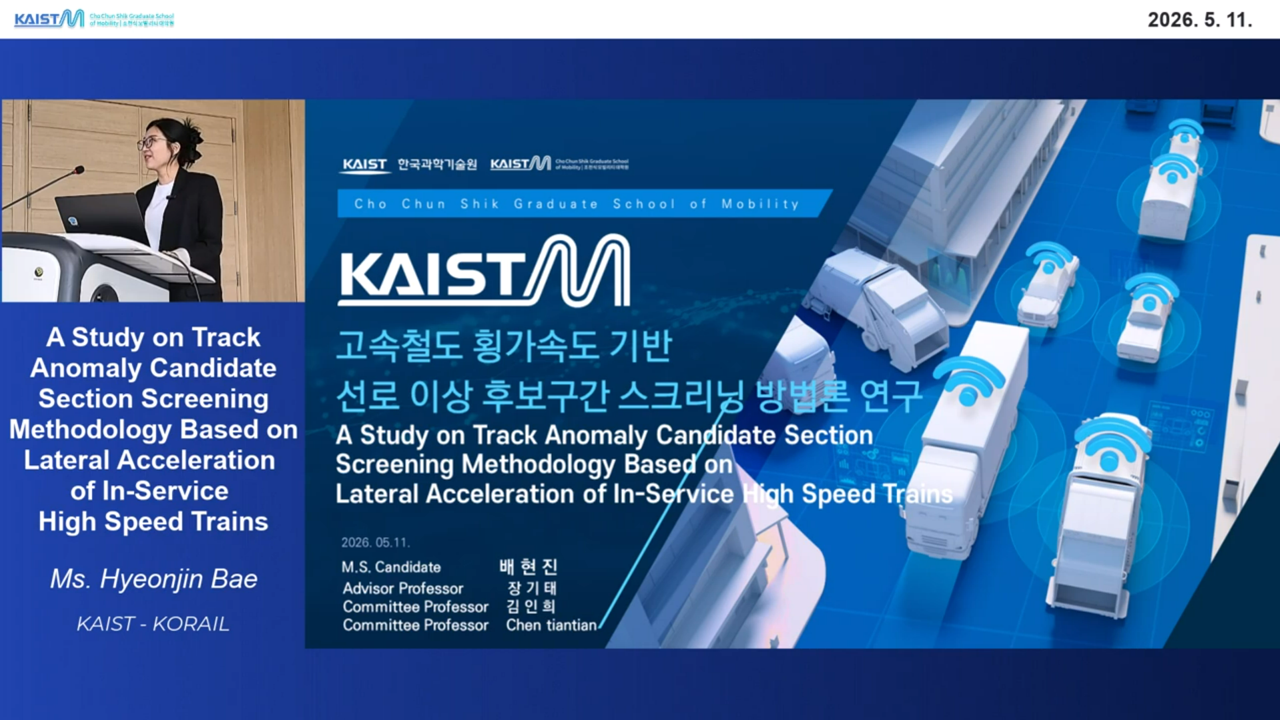
- 발표자 : Hyeonjin Bae (TOPS LAB)
- 일 시 : [Date, e.g., 2026. XX. XX]
- 소 속 : KAIST–KORAIL (Cho Chun Shik Graduate School of Mobility)
- 구 분 : 석사 학위 논문 심사 (M.S. Graduation Project Defense)
A Study on Track Anomaly Candidate Section Screening Methodology Based on Lateral Acceleration of In-Service High Speed Trains
Abstract
This video presents an M.S. Graduation Project defense at KAIST–KORAIL.
The research establishes a data-driven framework for high-speed rail safety monitoring using revenue-service trains as continuous sensors. Traditional track maintenance relies on periodic track recording cars (TRC), leaving significant observation gaps across time and location. To bridge this gap, this study proposes a machine learning approach focused on the screening stage to scan large-scale rail networks and identify prioritized track anomaly candidate sections.
Using a large-scale, one-year operating dataset from the KTX EMU-320 high-speed rail network, the study introduces a Two-Stream Quantile LSTM Autoencoder (LSTM-AE) architecture. A core contribution is the inclusion of a “static stream” that explicitly models vehicle factors (wheel wear) and environmental elements (ambient temperature) to disentangle systemic confounders from true track degradation signals. The framework further incorporates Conformalized Quantile Regression (CQR) to provide finite-sample, distribution-free statistical coverage guarantees, followed by a multi-channel k-vote spatial consensus algorithm to produce highly reliable candidate hotspot segments.
Presentation Overview
This presentation covers the following key topics:
- Why periodic inspection alone is not enough: The shift to condition-based screening
- Physical foundations of lateral vibration and hunting instability
- Multi-stage preprocessing and rigorous validation pipelines for position tracking
- Empirical evidence of vehicle-wheel wear confounding track vibration signals
- Two-Stream Quantile LSTM-AE model configuration and conformal calibration
- Hotspot screening via multi-stage sensor-level consensus filtering (k-vote)
- Convergence validation through permutation tests and Physical-Plausibility analysis