- Speaker : Prof. Takahiro Tsubota
- Date : July 1, 2026
- Affiliation : Associate Professor, Ehime University, Matsuyama, Japan
- Category : Special Lecture (2026 Jeju Summer Camp)
Interpretable and Reliable AI for Traffic Safety: From Risk Estimation to Risk-Aware Traffic Management
Abstract
This second special lecture at the 2026 Jeju Summer Camp moves from traffic flow to accident risk estimation, asking how risk can be measured, communicated, and used in day-to-day traffic management. Road deaths in Japan have fallen over the decades through infrastructure investment and safety education, but the risk that remains is spread thinly across many low-frequency locations instead of sitting at a handful of notorious blackspots. This long tail is difficult to treat with construction alone, which is the case the talk makes for dynamic, information-based countermeasures.
The first half examines risk information provision through an economics lens, built on a Japanese intercity expressway case study. Occurrence risk, monetary loss risk, and encounter risk each push route choice in a different direction, and drivers have real trouble reading very small probabilities. The most intuitive framing, avoiding the road where someone else’s crash is likeliest to be met, can raise total accident risk rather than lower it. A binary logit route-choice simulation compares expected accident counts with and without each type and format of risk information, on normal and busy days.
The second half turns to interpretable AI. A neural network predicts accident probability 30 minutes ahead from one hour of traffic conditions, trained and validated on nine years of Tomei Expressway data. A CNN reading probe-vehicle trajectory diagrams, paired with Grad-CAM, then localizes where inside a 15 km section the risk is emerging. The result is checked against recorded accident locations and benchmarked against a fixed historical-hotspot approach.
Presentation Overview
This presentation covers the following key topics:
- Motivation: the long-tail shape of traffic accidents in Japan today, and why dynamic measures are needed alongside hard infrastructure
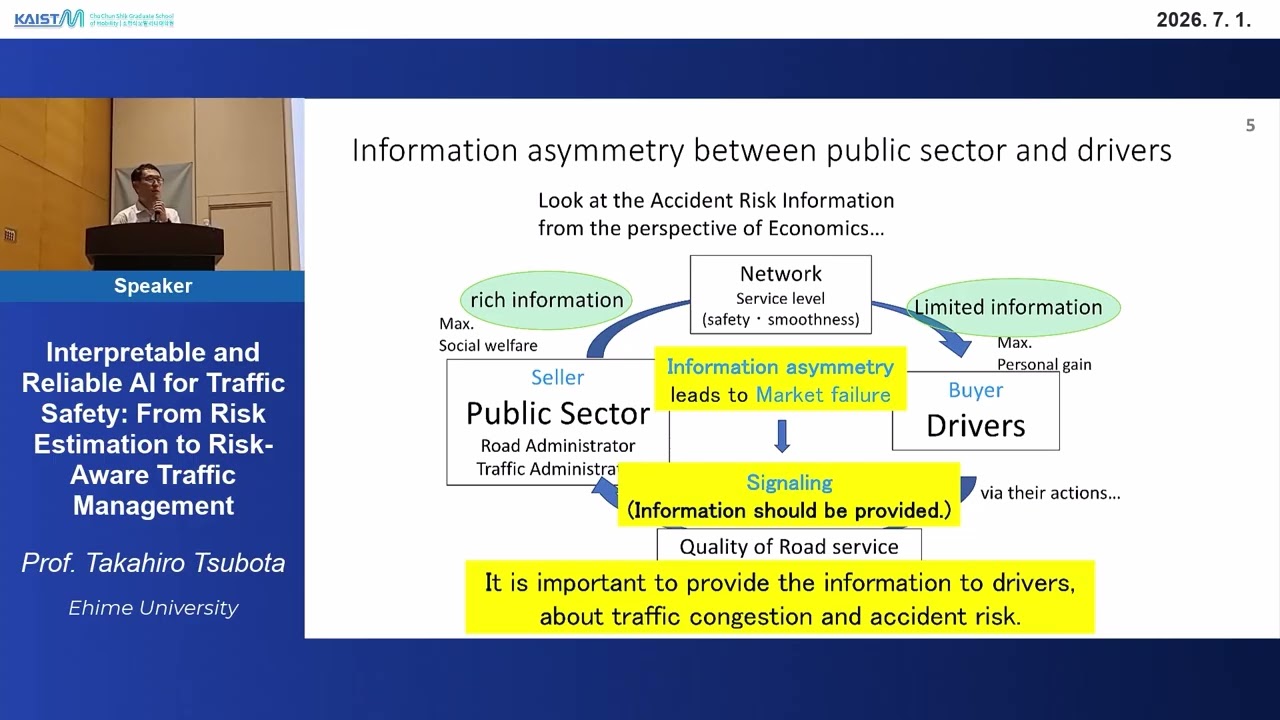
- An economics view of accident risk: the information gap between road administrators and drivers, and the case for telling drivers what the risk is
- Types of risk information: occurrence risk, monetary loss risk, and encounter risk, and how hard very small probabilities are to interpret
- The risk-information paradox: why choosing a route to avoid encountering a crash can work against minimizing your own accident risk, shown on a real North and South expressway pair
- Simulation study: binary logit route choice and expected accident counts under different types and formats of risk information, on normal and busy days
- Fundamentals of risk estimation: congestion, rainfall, and speed variance as risk factors, and where traditional GLM and Poisson models fall short
- AI-based prediction: a neural network for 30-minute-ahead accident probability, trained on nine years of Tomei Expressway data
- Interpretable localization: CNN plus Grad-CAM on probe trajectory diagrams to find high-risk points in space and time within a 15 km section, validated against real accident locations
- Takeaways: safety is now a long-tail problem, risk information design carries unintended consequences, and interpretable AI should show where and why risk is emerging rather than only predicting it