
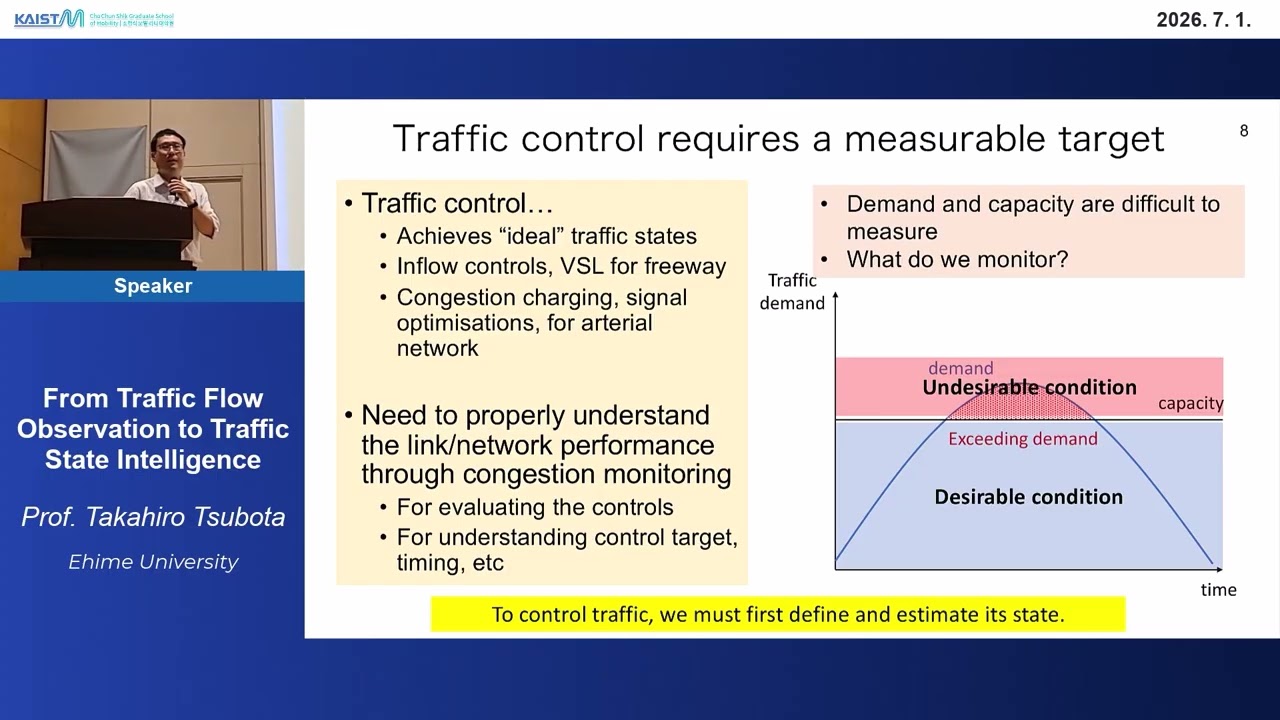
- Speaker : Prof. Takahiro Tsubota
- Date : July 1, 2026
- Affiliation : Associate Professor, Ehime University, Matsuyama, Japan
- Category : Special Lecture (2026 Jeju Summer Camp)
From Traffic Flow Observation to Traffic State Intelligence: Fusing Fixed Sensors and Probe Data for Urban Traffic Monitoring
Abstract
This special lecture, delivered at the 2026 Jeju Summer Camp, looks at how urban traffic congestion can be understood and managed through better observation of traffic state. It centers on a hard problem: estimating traffic density on signalized urban arterials, where direct measurement is difficult. Fixed point detectors give continuous but local readings, and probe-vehicle data offers only sparse, section-level coverage, so neither source alone captures the true state of a link, especially where mid-link sources and sinks, detector errors, and signal-induced queuing come into play.
To address this, the talk introduces a sensor-fusion approach that combines cumulative vehicle counts from fixed detectors with travel-time samples from probe data such as Bluetooth. Pairing the two corrects cumulative-count drift and recovers physically consistent link-level density. The method is validated in simulation under controlled error conditions and applied to real cases, including a signalized arterial in Brisbane and the wider Brisbane network, then extended to network-level traffic intelligence through the Macroscopic Fundamental Diagram (MFD).
Presentation Overview
This presentation covers the following key topics:
- Motivation: why timely, reliable traffic state information underpins congestion strategies (capacity increase, spatial and temporal demand redistribution)
- Fundamentals of traffic state: flow, density, and speed, and why the flow-density (fundamental diagram) relationship, not any single variable, defines congestion
- The estimation problem: why traffic is only ever partially observed, and the complementary strengths and limits of fixed detectors versus probe vehicles
- Urban arterial challenges: why methods built for motorways do not transfer directly to signalized arterials, and how detector placement (midblock vs stop-line) can bias the observed state
- Sensor-fusion methodology: cumulative-plot estimation, the cause of count drift from mid-link sources and sinks, and how probe trajectories anchor and correct the cumulative curves
- Validation and case studies: simulation accuracy under sink and source scenarios, sensitivity to Bluetooth penetration, and real-world application on Coronation Drive and the Brisbane network
- Network-level intelligence: extending link-level estimation to the MFD for regional monitoring and incident-impact assessment